In the early 1600s, the French colony of New France depended heavily on Indigenous guides, interpreters, and cultural intermediaries. Among those remembered in the historical record was Roch Manitouabeouich, an Indigenous man associated with the Huron and Algonquin worlds who became a guide and interpreter during the early years of the French presence in North America.
Roch was reportedly born on November 14, 1596, in the region of present-day Quebec. His father was Manitouabe8ich, with the number “8” reflecting an early Jesuit spelling convention used to represent the French ou sound. His mother is described in some early French records as a “Huron Sauvagesse.” This was a generic colonial term rather than a personal name and should not be treated as her documented name.
As a young man, Roch became associated with Olivier Le Tardif, one of the important French intermediaries in early New France. According to the historical tradition, Roch was hired as Le Tardif’s scout and traveling companion.
Olivier Le Tardif and Roch’s Role
Olivier Le Tardif worked as a representative and interpreter in the early French colony and was connected with the circle surrounding Samuel de Champlain. His work required extensive travel and communication with Indigenous nations. Roch’s knowledge of Indigenous languages and geography would have been extremely valuable. He was associated with the Algonquin and Huron-Wendat regions, and his ability to communicate across cultural and linguistic boundaries helped make travel and diplomacy possible.
His role as a guide and interpreter placed him within several important developments in early New France:
- The expansion of the fur trade along the St. Lawrence and Ottawa River corridors.
- Diplomatic travel between French settlements and Indigenous communities.
- Communication between French colonists and Indigenous nations.
- The movement of people, information, and goods through the vast territory surrounding the Great Lakes and St. Lawrence River.
For the French, Indigenous guides such as Roch provided knowledge of waterways, trails, settlements, languages, and customs that Europeans could not have acquired on their own.
Family Connections and Cultural Alliances
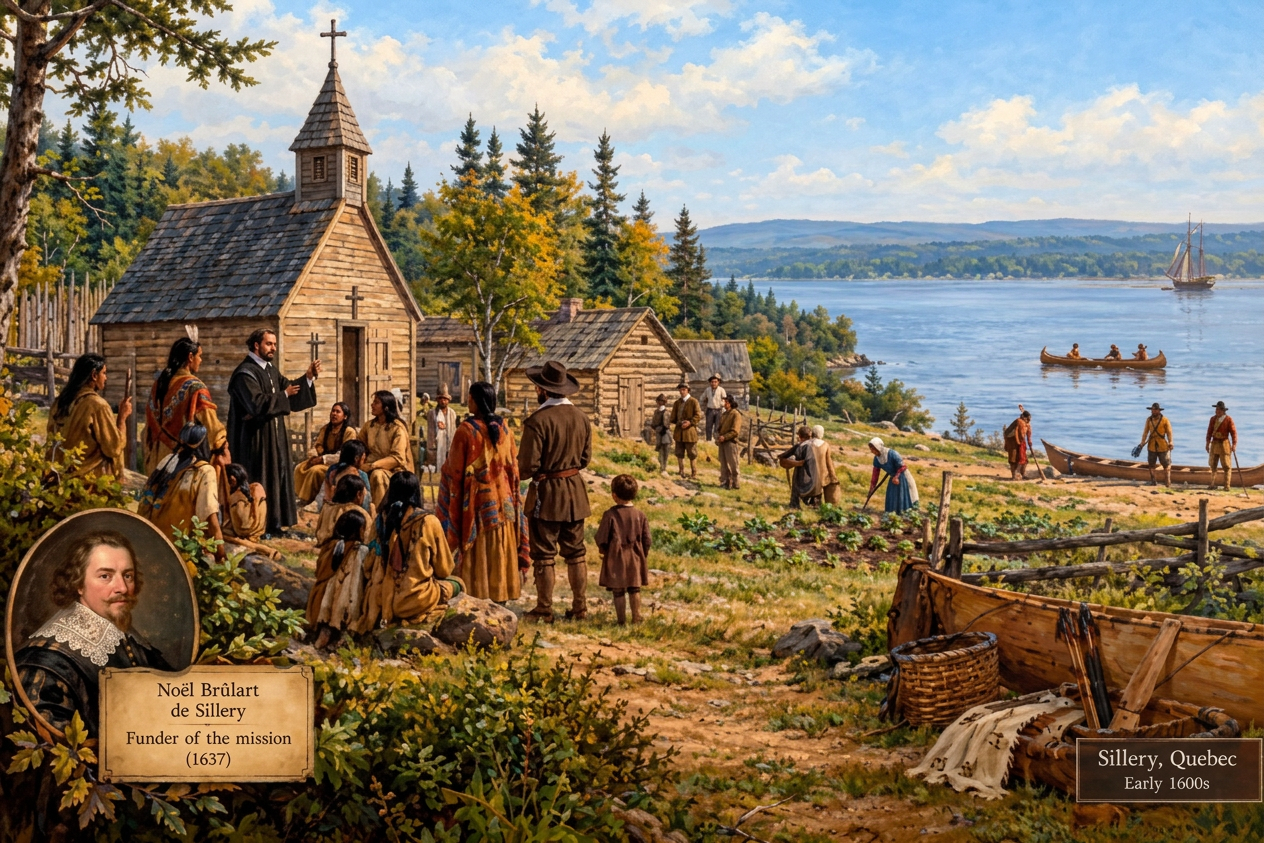
Roch’s family connections also appear to have been part of the complex network of relationships that linked Indigenous communities and the French colony. According to the tradition surrounding his family, Manitouabeouich married Oueou Outchibahanoukouéou. She was reportedly born around 1600–1602 near the Bécancour River and later lived in the area of Sillery, Quebec. Sillery became an important location in the history of relations between French settlers and Indigenous peoples. A mission was established there in 1637, with financial support from the French nobleman Noël Brûlart de Sillery.
Roch and his wife, Outchibahanoukouéou, are associated with the story of their daughter, Ouchistaouichkoue. According to the tradition, they entrusted their daughter to Olivier Le Tardif, who had her raised and educated within French society. She later became known as Marie-Olivier Sylvestre, who married Martin Prévost in 1644, in what is considered an important early example of a documented French-Indigenous marriage in New France.
Stories such as this illustrate how family relationships, baptism, education, godparent relationships, and other forms of kinship could connect Indigenous families with French colonial society. These relationships were more than simple family connections. They could also serve as bridges between cultures. Children who grew up moving between Indigenous and French worlds could become cultural intermediaries, helping people from different communities communicate with one another.
Roch’s Final Years
Roch Manitouabeouich is reported to have died on November 3, 1644, at a Huron camp in the region of present-day Michigan. The cause of his death is not identified in the information available here. For many Indigenous people living beyond the French parish system, especially those who were not baptized or whose deaths were not recorded by a French missionary, details such as the cause of death may simply not have been preserved.
Roch’s story therefore survives through scattered references rather than a single complete biography. His life nevertheless provides a glimpse into the complicated world of seventeenth-century New France, where French settlers depended upon Indigenous knowledge and where Indigenous people navigated relationships with the expanding French colony.
As a guide, interpreter, scout, and member of an Indigenous family connected to French society, Roch Manitouabeouich occupied a position between cultures. His story helps us understand that the history of New France was not created by Europeans alone. It was also shaped by the Indigenous men and women whose knowledge, languages, relationships, and travels made the early colony possible.


Leave a comment