Every family history has a beginning—or, more often, many beginnings. Sometimes those beginnings are found in a census record, an old letter, or a faded photograph. Other times, they are hidden in a church register written hundreds of years ago, in a place far from where the family eventually settled.
For the Allaire family history, one of those stories begins in Paris, France, with a man named Martin Prévost.
Martin Prévost was born on January 4, 1611, in Paris, France. His father, Pierre Prévost, was 36 years old, and his mother, Charlotte Vien, was 21. Martin was born during a time when France was looking across the Atlantic toward its growing colony in North America. What happened next would take Martin far from his birthplace and place him at the center of an important chapter in the early history of New France.
According to the U.S. and Canada, Passenger and Immigration Lists Index, 1500s–1900s, Martin arrived in Quebec in 1639. The record identifies Quebec, Canada, as his destination and cites page 92. His arrival marked the beginning of a new chapter in his life, as he became part of the growing French community in New France.
But his story would become especially significant because of the family he began in Quebec.
A Marriage Recorded in 1644
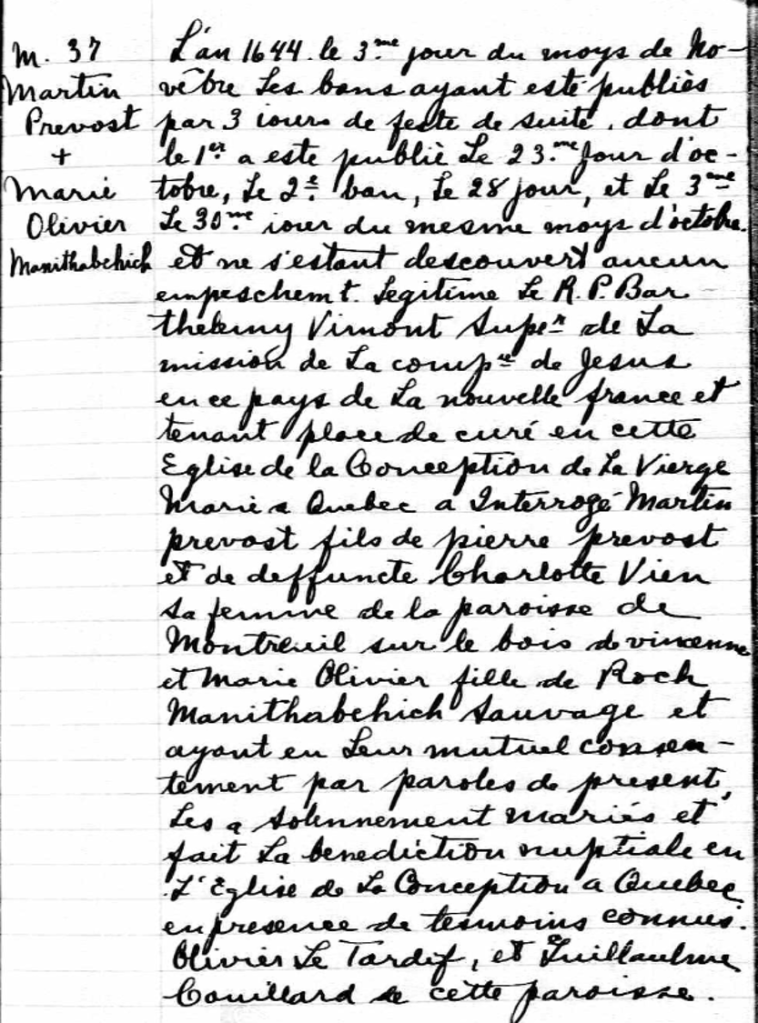
On November 3, 1644, Martin Prévost married Marie Manitouab8ich, an Indigenous woman. Their marriage is among the earliest documented French-Indigenous marriages in New France.
The record was written in Quebec and provides an extraordinary glimpse into the lives of two people living in New France nearly four hundred years ago.
Before the marriage could take place, the church required the banns to be announced on three successive feast days. The first announcement was made on October 23, followed by announcements on October 28 and October 30. No legitimate impediment to the marriage was discovered.
The Reverend Father Barthélemy Vimont, Superior of the Jesuit mission in New France and serving as parish priest at the Church of the Conception of the Virgin Mary in Quebec, then questioned the couple and received their mutual consent.
The record identifies Martin as the son of Pierre Prévost and the late Charlotte Vien, from the parish of Montreuil-sur-le-Bois-de-Vincennes. Marie was identified as the daughter of Roch Manithabehich.
With their consent given, Father Vimont solemnly married the couple and gave them the nuptial blessing. Two witnesses were present: Olivier Le Tardif and Guillaume Couillard, both associated with the parish.
Their marriage became part of the complicated and changing population of New France, where French settlers and Indigenous peoples lived alongside one another in a developing colonial society.
Historical sources describe marriages between Europeans and Indigenous people as representing a relatively small proportion of the overall population of mixed ancestry in Canada. Martin Prévost’s marriage in 1644 nevertheless stands as an important early example of a French-Indigenous marriage documented in New France.
From New France to the Generations Beyond
Martin and Marie went on to have ten children together.
Marie died at the age of 41, while Martin lived to the age of 80, a long life for his time. He died on January 27, 1691, in Beauport, Quebec, and was buried there.
By the time of his death, Martin had spent most of his adult life in North America. The young man born in Paris had become part of the early history of Quebec and had created a family whose descendants would continue through the generations.
And that is where the story becomes especially interesting for family historians.
Following the Thread
When we research family history, it is easy to become focused on dates and names. But behind every name is a person.
Among Martin Prévost’s descendants was Jules Lambert dit Champagne, described in this family line as Martin’s sixth great-grandson.
Jules was born on October 27, 1836, in Sainte-Marie, Quebec, Canada. His father, Jean-Baptiste Lambert, was 33 years old, and his mother, Christine Bisson, was 24.
On January 11, 1859, Jules married Emmélie Turcot in Quebec. Together, Jules and Emmélie built a large family. Over the course of 19 years, they had 11 children.
Their story gives us another glimpse into the generations that followed Martin Prévost. Nearly two centuries had passed since Martin’s marriage in Quebec, yet the family line continued to grow in the same province where Martin had established his family.
Once again, the generations continued.
From Quebec to New Hampshire
As family historians, this is the part of the journey that makes us pause.
A man born in Paris in 1611 began a family in Quebec. His descendants continued to live, marry, raise children, and build their own lives. Eventually, one branch of that family reached New Hampshire.
One of Martin Prévost’s later descendants—a ninth great-granddaughter—was born in Lyme, New Hampshire.
Her story is very different from Martin’s, yet there is something familiar about it. She grew up surrounded by family, community, education, and the New Hampshire landscape.
As a young girl, she took part in the annual Christmas pageants at the Lyme Congregational Church. Her accomplishments would eventually extend far beyond her small New Hampshire community.
She became an award winner for a free art course at the Boston Museum School and was recognized on the Hanover High School Honors List.
She went on to attend Brandeis University, where she earned a degree in Philosophy and received the Philosophy Award.
Her education continued, and she later received a master’s degree from Harvard College.
Yet education and accomplishments are only part of her story.
Today, she continues to have a meaningful connection to the community and serves as a loyal patron of the Town of Warren. She divides her time among family and friends, gardening, and enjoying the outdoors. She is a talented horticulturist and someone who brings curiosity, kindness, and generosity to the people and places around her.
For those who know her, she is deeply valued and appreciated.
For a family historian, her story offers something especially meaningful. It shows how a family line that began with a young man born in Paris more than four hundred years ago can eventually become part of the story of a small New Hampshire town.
The Threads of a Family
This is what I love about family history.
At first, a name on a genealogy chart can seem like nothing more than a name. But when we slow down and look more closely, that name becomes a person.
We begin to see the journey.
We see a young man leaving France and becoming part of the early history of New France. We see a marriage recorded in an old Quebec church. We see children and grandchildren. We see descendants such as Jules Lambert dit Champagne, born in Sainte-Marie, Quebec, more than two hundred years after Martin.
And then we follow the family even farther.
Eventually, one branch reaches Lyme, New Hampshire, where a descendant grows up participating in local traditions, pursuing education, developing a love of art and philosophy, and eventually becoming connected to the community of Warren.
That is the wonder of genealogy.
The farther back we look, the more we sometimes understand about where we are today.
A family tree is not simply a collection of names and dates. It is a story of people, places, journeys, and connections that stretch across generations.
And sometimes, when we follow those branches far enough, we discover that a story that began in Paris, France, more than four hundred years ago eventually leads us right back home.


Leave a comment